Architectural 3D Rendering Cost: 2025 Price Guide
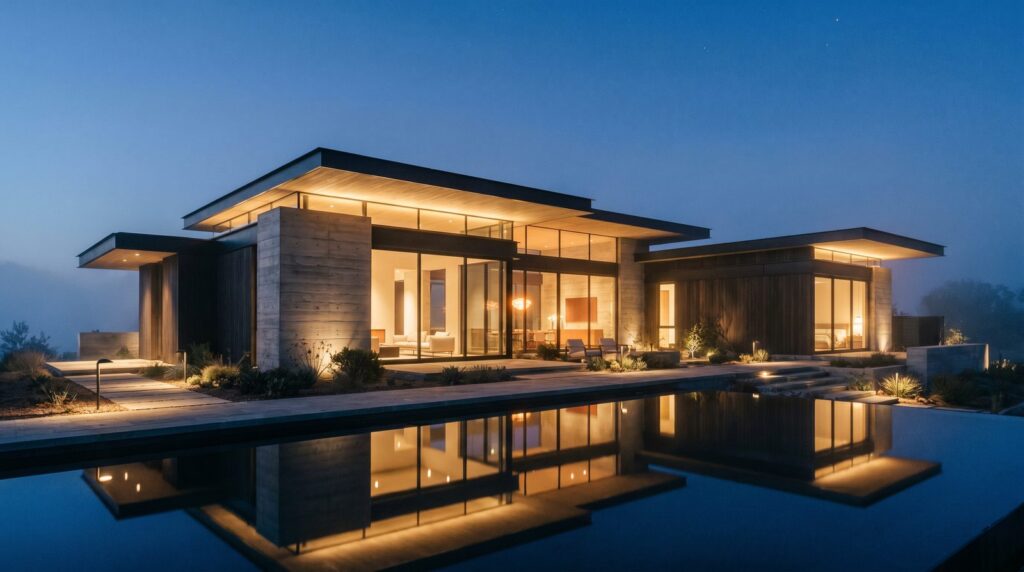
Architectural 3D rendering in the US typically runs $300–$1,500 per image for residential projects and $1,500–$6,000+ per image for large commercial or mixed-use work. The final number depends on four things: project type, scene complexity, turnaround speed, and the studio’s production tier. Understanding those levers before you request a quote puts you in control of the budget from day one.
Architectural 3D Rendering Pricing at a Glance (2025)
The table below reflects market-rate ranges for US-based and US-serving studios producing photorealistic, marketing-ready renders — not offshore commodity work.
| Render Type | Entry-Level | Mid-Tier | Premium / Complex |
|---|---|---|---|
| Exterior – Single-Family Residential | $300–$600 | $600–$1,200 | $1,200–$2,500 |
| Exterior – Multifamily / Condo Tower | $800–$1,500 | $1,500–$3,000 | $3,000–$6,000+ |
| Interior – Single Room | $300–$500 | $500–$1,000 | $1,000–$2,000 |
| Interior – Amenity / Lobby / Hospitality | $700–$1,200 | $1,200–$2,500 | $2,500–$5,000 |
| Landscape / Site / Aerial | $500–$900 | $900–$2,000 | $2,000–$5,000+ |
| Walkthrough Animation (per 30 sec) | $1,500–$3,000 | $3,000–$6,000 | $6,000–$15,000+ |
For a deeper breakdown specific to your project type, see our dedicated 3D rendering cost page where we walk through scope variables in detail.
Exterior Rendering Cost: What Drives the Price
Exterior renders are the most requested deliverable for developers and builders — and the price range is wide for good reason. A straightforward single-family home with clean geometry and a daytime lighting setup sits at the lower end. A mixed-use tower with custom entourage, multiple camera angles, dusk lighting, and surrounding context geometry sits at the top.
Key cost drivers for exterior renders
- Building scale and geometry complexity — curved facades, intricate cladding patterns, and large footprints all add modeling time.
- Number of camera angles — each additional view is typically priced at 50–70% of the first-image rate when ordered together.
- Lighting scenario — daytime is baseline; twilight or dusk adds roughly 20–40% due to extended render and compositing time.
- Site context — generic landscaping is fast; custom neighborhood context, specific street furniture, or aerial drone-match perspectives require extra modeling.
- Source files — clean Revit or SketchUp models reduce prep time; PDFs and hand sketches increase it.
Explore the full scope of what’s included in a professional exterior package on our exterior rendering services page.
Interior Rendering Cost: Room Type & Complexity
Interior renders are priced by scene complexity more than square footage. A minimalist bedroom with off-the-shelf furniture and neutral finishes costs less than a custom kitchen with detailed millwork, reflective surfaces, and layered lighting. Hospitality and amenity spaces — lobbies, fitness centers, rooftop lounges — command the highest interior rates because of their furniture density and lighting complexity.
Typical interior render price ranges by room
- Bedroom / bathroom: $300–$900 (standard residential)
- Kitchen / living room: $500–$1,200 (moderate cabinetry and material detail)
- Lobby / amenity space: $1,200–$3,500 (custom FF&E, complex lighting rigs)
- Restaurant / hospitality: $1,500–$5,000 (high material count, brand-specific fixtures)
- Office / commercial tenant: $700–$2,000 (depends on open-plan vs. built-out)
See the full interior visualization workflow and deliverable options on our interior rendering services page.
Landscape & Site Rendering: What to Budget
Landscape and site renders are often underestimated in scope. A pool-and-patio view for a custom home is straightforward. A master-planned community site plan rendered in 3D — with accurate tree species, hardscape, water features, and aerial perspective — is a multi-day production. Budget $500–$2,000 for residential landscape scenes and $2,000–$5,000+ for large-scale site or aerial renders used in entitlement packages or investor decks.
Pool renders specifically have become a standalone deliverable for luxury builders. A cinematic pool scene with evening lighting and landscaping typically runs $800–$2,500 depending on complexity.
Per-Image vs. Package Pricing: Which Makes Sense for Developers
Most studios offer both per-image rates and bundled packages. Here’s how to think about each:
| Pricing Model | Best For | Typical Savings |
|---|---|---|
| Per-image | Single renders, early feasibility studies, one-off additions | None — full rate applies |
| 3–5 image package | Single-family custom homes, small multifamily | 10–20% vs. individual rates |
| Full marketing package (6–12 images) | Condo developments, mixed-use, investor decks | 20–35% vs. individual rates |
| Retainer / ongoing partnership | Developers with multiple active projects | Negotiated — often 25–40% |
For developers running multiple projects simultaneously, a retainer arrangement locks in priority scheduling and consistent visual style across your entire portfolio — often the highest-ROI way to buy rendering services.
5 Factors That Raise (or Lower) Your Final Quote
Every studio prices differently, but these five variables move the needle on virtually every quote you’ll receive.
- Source file quality. A clean, dimensionally accurate Revit or SketchUp model is the single biggest cost reducer. Incomplete drawings or sketch-only input can add 20–50% in modeling time.
- Revision rounds. Most studios include 2–3 revision rounds. Unlimited-revision scopes or late-stage design changes after approval cost extra — sometimes significantly.
- Turnaround time. Rush delivery (under 48–72 hours) typically carries a 25–50% surcharge. Planning your rendering schedule in advance is free money.
- Licensing and usage rights. Standard deliverables cover marketing use. Broadcast, billboard, or third-party licensing may require upgraded terms.
- Studio tier and location. US-based premium studios charge more than offshore vendors — but deliver faster communication, revision responsiveness, and renders calibrated to US market expectations.
How to Get Maximum ROI From Your Rendering Budget
The goal isn’t the cheapest render — it’s the render that closes the deal, wins the approval, or moves the pre-sale. Here’s how experienced developers stretch their rendering budget without sacrificing quality:
- Front-load your best angles. Identify the two or three views that will appear on your website, sales collateral, and investor deck. Invest in those first.
- Batch your revisions. Consolidate all feedback into a single round rather than sending changes piecemeal. It saves time on both sides.
- Reuse scene assets. A studio that has already built your exterior scene can produce additional angles, lighting variations, or seasonal versions at a fraction of the original cost.
- Provide complete materials early. Finalize your finish schedule, fixture selections, and landscape plan before the render brief. Late swaps are the most common source of cost overruns.
- Think in campaigns, not images. A 6-image package designed for a specific sales campaign — hero exterior, two interiors, pool, aerial, and lobby — is more persuasive than six disconnected views ordered at different times.
Ready to get a project-specific number? Request a quote from Ratio Visuals and we’ll turn around a scoped estimate within one business day.
Frequently Asked Questions
What is the average cost of a single architectural 3D rendering in the US?
For a standard residential exterior or interior render from a US-tier studio, expect to pay $500–$1,500 per image. Simple scenes with clean source files and standard turnaround sit at the lower end; complex geometry, custom materials, or rush delivery push toward the higher end. Large commercial or mixed-use renders routinely exceed $2,000–$4,000 per image.
Why do some studios charge $150 per render while others charge $1,500?
Price reflects production quality, communication responsiveness, revision depth, and calibration to your market. Budget offshore vendors can produce fast, low-cost images — but they frequently require heavy revision cycles, deliver generic lighting and entourage, and lack the contextual knowledge of US real-estate marketing standards. For a sales brochure or investor deck, the cost of a substandard render is measured in lost deals, not saved dollars.
How many renders do I need for a typical residential development?
A well-rounded marketing package for a single-family custom home typically includes 3–5 images: one or two hero exteriors, a key interior (kitchen or great room), and a landscape or pool view. A small multifamily or townhome development generally needs 6–10 images to cover the exterior, shared amenities, and representative unit interiors. Larger condo or mixed-use projects often require 12–20+ images for a complete sales and entitlement package.
Does providing my own 3D model reduce the cost?
Yes — significantly. A clean, complete Revit, SketchUp, or ArchiCAD model eliminates the modeling phase, which can represent 30–50% of total production time on complex projects. Make sure your model is dimensionally accurate, has all major design decisions locked in, and includes a finish/material schedule. Incomplete models sometimes cost more to clean up than starting from scratch.
How long does it take to produce an architectural rendering?
A standard residential render from a professional studio typically takes 5–10 business days from approved brief to final delivery. Complex commercial projects or large packages run 2–4 weeks. Rush delivery within 48–72 hours is available from most premium studios but carries a surcharge. The fastest way to compress timelines is to provide complete, approved source files at the start of the project.