3D Rendering for Investor Decks: What to Include and Why
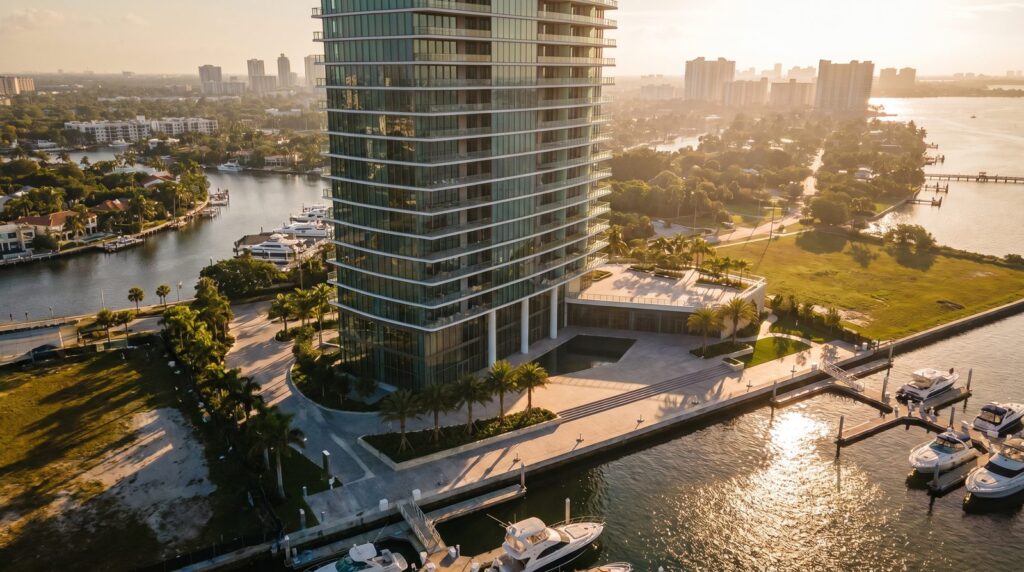
Real estate developers use 3D rendering in investor decks to close the perception gap between a set of drawings and a fundable project. A well-sequenced package typically includes an aerial site-context view, two or three photorealistic exterior hero shots, one or two interior unit renders, and a site or amenity plan — enough to let a lender or equity partner visualize the asset’s quality and market position before a shovel breaks ground. The goal is not decoration; it is risk reduction for the capital provider.
Why Investors Respond Differently to Renders Than to Drawings
Architectural drawings communicate intent to design professionals; renders communicate value to capital providers. A lender reviewing a multifamily deal does not read floor plans the way an architect does — they read comparable sales, absorption rates, and perceived quality. A photorealistic exterior render answers the question a drawing cannot: what will this actually feel like to a renter or buyer?
In our exterior work with US developers, we consistently see the same dynamic: projects that arrive at investor meetings with strong renders close faster than those relying on schematics alone, because the render pre-answers objections. The equity partner does not have to imagine the rooftop amenity or the lobby finish — they can see it. That shift from imagination to visualization materially reduces perceived risk, and reduced perceived risk is the most direct lever on deal terms.
Renders also signal developer sophistication. A polished capital-raise package tells the room that the team has thought through the product in detail. Lenders and institutional equity partners have seen enough deals to know that a developer who has not resolved the design well enough to render it probably has not resolved the pro forma well enough to fund it.
Which Render Types Belong in an Investor Deck (and Which to Skip)?
Not every render type earns its place in a capital-raise context. The right assets communicate project quality and market fit efficiently; the wrong ones add cost and visual noise without moving the needle on investor confidence.
| Render Type | Include in Investor Deck? | Primary Purpose |
|---|---|---|
| Aerial / site-context view | Yes — always | Shows location quality, density, and neighborhood context |
| Exterior hero shot (day or dusk) | Yes — 2 to 3 views | Communicates architectural quality and curb appeal |
| Interior unit render (primary unit type) | Yes — 1 to 2 views | Justifies rent or price point with finish-level evidence |
| Amenity or common-area render | Yes — if amenities drive the rent premium | Supports NOI assumptions with lifestyle imagery |
| Landscape / pool render | Selective — include for luxury or resort product | Differentiates outdoor living; supports premium positioning |
| Walkthrough animation | Rarely at early capital raise; better for pre-sales | High-impact but adds cost and time; reserve for final equity close |
| 3D floor plans | Optional — useful for unit-mix clarity | Helps investors understand unit efficiency without reading 2D plans |
| Interior bathroom / secondary rooms | No — unless spec is a differentiator | Adds little at capital-raise stage; save for marketing phase |
The short version: lead with context (aerial), establish quality (exterior hero), prove the rent story (interior and amenity). Everything else is a judgment call based on what your specific deal needs to justify.
For a deeper look at the full range of render types available for developer projects, see our real estate rendering services overview.
How Many Views Does a Capital-Raise Package Typically Need?
A focused investor-deck render package for most US multifamily or mixed-use deals runs five to eight images. More than that rarely adds persuasive value at the capital-raise stage — it adds production cost and dilutes the strongest images.
- 1 aerial or site-context render — establishes location, scale, and neighborhood quality
- 2–3 exterior views — primary street elevation, an approach angle, and optionally a dusk or twilight version of the hero shot
- 1–2 interior renders — the primary unit type kitchen or living area, plus the lobby or a signature amenity
- 1 landscape or amenity render — pool deck, rooftop, or courtyard if it supports the rent premium
Smaller deals — a boutique condo building, a single-family subdivision — can often make a strong case with four to five renders. Larger institutional packages (a 300-unit tower, a mixed-use block) may justify ten or more, but even then the deck itself should lead with five to seven and use the rest as appendix material.
What Information Should Each Render Communicate to a Lender?
Every render in an investor deck should answer a specific underwriting question, not just look attractive. Lenders and equity partners are running a mental checklist while they flip through your deck — your renders should resolve items on that list, not just fill white space.
The aerial view should communicate: Where is this relative to employment, transit, and retail? What is the neighborhood density and trajectory? Does the site have any obvious constraints (power lines, industrial adjacency, flood zone)? A well-composed aerial render places the project in its real context, using accurate site geometry and surrounding building massing.
Exterior hero shots should communicate: What is the material quality and architectural language? Does this read as the product type the pro forma claims — workforce housing, Class A luxury, boutique condo? Lighting matters here. A dusk or late-afternoon render conveys warmth and livability in a way a flat midday render does not. In our exterior visualization work, we find that dusk lighting consistently reads as higher quality to non-design audiences, which is exactly the audience reviewing a capital-raise deck.
Interior renders should communicate: Do the finishes justify the asking rent or sale price? Is the unit layout efficient and livable? Lenders who have seen a lot of multifamily deals can read finish levels from a render — quartz counters versus laminate, wide-plank LVP versus carpet, integrated versus surface-mounted fixtures. Make sure your render reflects the actual spec you are building, not an aspirational upgrade.
Amenity renders should communicate: What is the lifestyle proposition that supports the rent premium in your pro forma? A rooftop deck render that shows a credible, well-designed space gives the lender a reason to believe your market-rate assumption. A generic pool render does not.
How Do You Sequence Renders Through a Funding Round?
Render sequencing through a funding round follows the logic of the capital stack: earlier-stage capital needs enough to believe; later-stage capital needs enough to commit. Do not spend your full render budget before your first lender meeting.
Pre-application / early equity conversations: One strong aerial and one exterior hero shot are often enough to get the first meeting. These establish that the project is real and the developer has thought through the design. Full packages at this stage often go unread.
Construction loan application: This is where a complete render package pays its highest return. The lender’s credit committee needs to see the full product — aerial, exterior elevations, primary interior, amenities. A polished five-to-seven-image package signals that the developer is execution-ready.
Equity close / final LP presentation: If your deal includes a walkthrough animation or a more extensive interior package, this is the right moment. The equity partner is making a large, long-dated commitment and benefits from the most immersive visualization available. Our guide to pre-sales and investor decks covers the broader marketing lifecycle in more detail.
Pre-sales and lease-up: This is a separate phase with different render needs — more interior types, lifestyle photography-style compositions, social-format crops. Do not conflate the capital-raise package with the pre-sales package; they serve different audiences and different decisions.
Aerial and Site-Context Renders: Why They Matter for Investor Confidence
The aerial render is the single most underused asset in developer capital-raise packages, and often the single highest-return image in the deck. It answers the question every lender asks first: where exactly is this, and what surrounds it?
A site-context aerial does more than show a bird’s-eye view. Produced correctly, it places the proposed building mass within accurate surrounding geometry — neighboring structures, street grid, parking, green space, water — so the lender can immediately read proximity to amenities, site constraints, and neighborhood quality. This is information that a map screenshot does not convey and that a street-level exterior render cannot show.
For larger master-planned projects, a masterplan render that shows phasing, site circulation, and amenity placement is equally important. It lets the capital provider understand the full project scope and the logic of the development sequence. Our aerial and masterplan rendering guide walks through exactly what inputs are needed to produce these views accurately.
One practical note: aerial renders require accurate site survey data and surrounding building massing to be credible. A loosely approximated aerial that misrepresents the site context will undermine trust rather than build it. Provide your studio with the site plan, a survey, and any available GIS or massing data for the surrounding blocks.
How Much Does an Investor-Deck Render Package Cost?
Because every project is different, the cost of an investor-deck render package depends on several compounding factors rather than a flat rate. Understanding those drivers helps developers budget accurately and prioritize the right assets.
Building type and complexity are the primary drivers. A straightforward three-story townhouse community requires less modeling time than a 20-story mixed-use tower with a complex curtain wall system. More geometry, more materials, and more custom detailing all increase production time.
Number of views and render types scale cost directly. Each additional camera angle and lighting condition — a dusk version of an exterior hero, a second interior type — adds to the package. Aerial and site-context renders typically require more modeling setup than standard exterior views because the surrounding context must be built out accurately.
Turnaround timeline affects cost. Investor decks often have hard deadlines tied to lender meetings or LP presentations. Rush production is possible but carries a premium; planning your render schedule four to six weeks ahead of a funding milestone is the most cost-effective approach.
Revision depth matters too. Packages that require multiple design-level revisions — changing the facade material system, repositioning massing, updating the landscape plan — take longer than packages where the design is resolved before production begins.
For a detailed breakdown of what drives render pricing across project types, see our 3D rendering cost guide.
Frequently Asked Questions
Can I use renders in an investor deck before the design is fully resolved?
Yes, but with an important caveat: renders should reflect the design as it will actually be built, not an idealized version. Lenders who later see a gap between the render and the permitted plans lose confidence. Produce renders once the massing, unit mix, and primary material palette are locked — not at the concept sketch stage.
Do lenders and equity partners actually look at the renders, or do they focus on the numbers?
Both. Experienced capital providers read the pro forma first, but renders validate the assumptions behind it. A rent premium that looks aggressive on paper becomes credible when the interior render shows a finish level that supports it. Renders and financials work together — one without the other leaves gaps that sophisticated investors notice.
What file formats and sizes should renders be delivered in for an investor deck?
For a PowerPoint or PDF deck, high-resolution JPEGs at 300 DPI or a minimum of 3000 pixels on the long edge are standard. Request both print-resolution files and screen-optimized versions for digital distribution. If the deck will be presented on a large display, confirm the resolution requirement with your studio before delivery.
Is a walkthrough animation worth the cost at the capital-raise stage?
Rarely for the initial capital raise. Animations are most valuable at the equity-close or pre-sales stage, when the deal is further along and the audience has more time to engage with a video. At early lender meetings, a strong still-image package almost always delivers a better return on the production budget than an animation.
How far in advance should I commission renders before a lender meeting?
Allow four to six weeks minimum for a full investor-deck package — longer if the design is still being resolved or if the project involves complex massing and site context. Rushing render production increases the risk of errors in the design representation, which is the last thing you want a lender to catch during due diligence.
If you are preparing a capital-raise package and want to discuss which render types make the most sense for your project type and timeline, reach out to the Ratio Visuals studio — we work with US developers at every stage of the funding process.
Last updated: July 2026