In-House vs Outsourced 3D Rendering: A Developer’s Guide
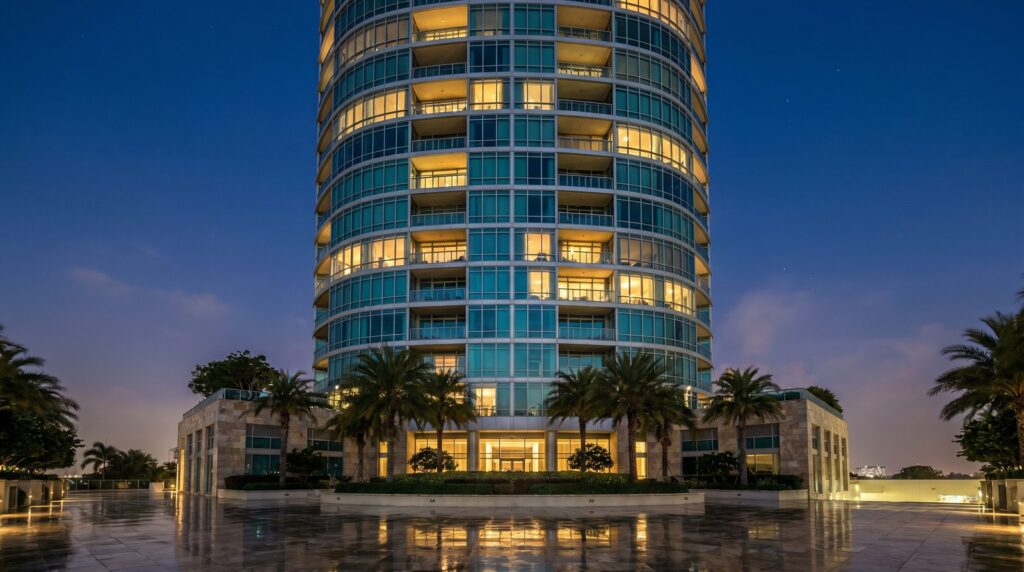
For most US real-estate developers, outsourcing to a specialist studio produces higher-quality results faster and at lower total cost than building an in-house team — especially below a threshold of roughly a dozen active rendering projects per year. In-house capability only pays off when render volume is continuous, the team is large enough to justify full-time salaries, and brand consistency across dozens of projects per year outweighs the flexibility of on-demand outsourcing.
What Does It Cost to Build an In-House Rendering Capability?
The true cost of an in-house rendering operation is almost always underestimated at the outset. The visible expenses — software licenses and hardware — are real, but they are typically the smaller part of the total.
The dominant cost is talent. A skilled architectural visualizer with production-level proficiency in software such as 3ds Max, V-Ray, Lumion, or Enscape commands a competitive salary. You also need to budget for benefits, payroll taxes, recruiting fees, and ongoing training as software platforms evolve. One person is rarely enough for a development firm with active marketing cycles; a credible in-house team typically means two or more full-time roles.
Beyond salaries, consider:
- Workstation hardware — photorealistic rendering is GPU- and CPU-intensive; professional-grade machines require meaningful capital investment and depreciate.
- Software licenses — rendering suites, CAD interoperability tools, and asset libraries carry annual subscription costs that compound across seats.
- Render farm access — for animation or high-resolution stills, even in-house teams often need cloud rendering credits on top of local hardware.
- Management overhead — someone senior must brief, review, and quality-control the output, which pulls director or marketing-manager time.
- Idle capacity — rendering demand is project-driven. Between launches, a full-time team is a fixed cost with variable output.
For a detailed breakdown of what drives rendering costs regardless of delivery model, see our 3D rendering cost guide.
What Does Outsourcing to a 3D Rendering Studio Actually Cost?
Outsourcing converts a large fixed cost into a variable one: you pay per project, per view, or per deliverable — and only when you need it. Because config.pricingReference is not populated here, we won’t invent figures; what matters is understanding the drivers that determine what a studio will quote.
The factors that move an outsourced rendering quote up or down include:
- Building type and complexity — a single-family coastal home is simpler to model than a 20-story mixed-use tower with curtain-wall glazing and a podium retail level.
- Number of views — each unique camera angle requires its own lighting setup, foreground dressing, and post-production pass.
- Lighting scenario — daytime exterior renders are fastest; dusk/twilight shots and interior lit scenes require more render time and compositing.
- Material and finish complexity — PBR-accurate stone, brushed metal, or custom tile patterns take longer to texture than standard brick or painted stucco.
- Animation vs stills — a walkthrough animation involves camera path planning, frame-by-frame rendering, and video post-production, making it substantially more involved than a still image.
- Turnaround urgency — rush delivery typically carries a premium.
- Revision rounds — studios price differently on how many revision cycles are included versus billed separately.
To understand what a specific project scope is likely to involve, visit our real-estate rendering services page or request a tailored quote.
How Do Turnaround Times Compare for In-House vs Outsourced Renders?
Turnaround speed depends less on where the work happens and more on who is available to do it right now.
An in-house team appears faster on paper — no briefing handoff, no back-and-forth with an external studio. In practice, in-house artists are often juggling multiple projects simultaneously, and a last-minute request from sales can stall a project already in progress. There is no surge capacity: if two major launches collide, something waits.
A well-run outsourced studio operates the opposite way. Because it handles volume across many clients, it can allocate dedicated artists to your project and absorb peaks without the bottleneck. From our own production experience at Ratio Visuals, a clearly briefed exterior render — provided we have the architectural files, material palette, and site context — typically moves from modelling to first draft faster than most developers expect, because the pipeline is purpose-built for this single task.
The single biggest turnaround variable in either model is the quality of the brief. Incomplete drawings, missing material specs, or unclear camera direction cause delays regardless of whether the artist is in your office or across the country. Our project brief checklist outlines exactly what to prepare before any render starts.
Which Option Produces Higher-Quality, More Photorealistic Results?
Specialist studios consistently produce more photorealistic output than generalist in-house teams, for a straightforward reason: photorealism is the studio’s only product.
At Ratio Visuals, every artist works exclusively on architectural visualization. That focus produces depth of craft that is hard to replicate with a small in-house team whose members must also handle floor plan graphics, presentation decks, or marketing collateral. Techniques like physically based rendering (PBR) material calibration, global illumination tuning, atmospheric haze, and cinematic post-production compositing take years of project-specific repetition to master.
In-house teams can absolutely produce competent renders. But “competent” and “photorealistic enough to close a pre-sales buyer or impress an investor” are different bars. The renders that appear in premium development brochures, on hoarding boards, and in digital ad campaigns are almost universally produced by dedicated visualization studios.
Quality also compounds over time: a studio that has rendered dozens of coastal condominiums has a library of refined lighting setups, landscape assets, and material libraries that an in-house team building from scratch simply does not have on day one.
In-House vs Outsourced Rendering: Side-by-Side Comparison
| Factor | In-House Team | Outsourced Studio |
|---|---|---|
| Cost structure | High fixed cost (salaries, hardware, software) | Variable — pay per project or deliverable |
| Cost efficiency at low volume | Poor — fixed costs spread over few projects | Strong — no idle overhead |
| Cost efficiency at very high volume | Can improve — fixed cost amortised | Remains competitive; no capital risk |
| Photorealism ceiling | Limited by team size and specialisation | High — specialist craft and asset libraries |
| Turnaround (steady state) | Fast if team is free | Fast with a clear brief and good studio |
| Surge capacity | None — bottleneck at peak | Strong — studio absorbs volume spikes |
| Brand consistency | High — single team, single style | High if you use one dedicated studio |
| Software & tech currency | Requires ongoing training investment | Studio handles; you benefit automatically |
| Management overhead | High — HR, reviews, equipment | Low — brief, review, approve |
| Risk | High — staff turnover disrupts pipeline | Low — studio redundancy covers individuals |
When Does In-House Rendering Make Sense for a Developer?
In-house rendering is worth serious consideration only when several conditions align simultaneously.
First, volume must be continuous and very high. If your development pipeline reliably generates a large number of rendering deliverables every month — not just at launch, but throughout the year — the fixed cost of a full-time team begins to amortise meaningfully.
Second, you need real-time or near-real-time iteration. Some developers use real-time engines (Unreal Engine, Enscape, or Lumion) for live design reviews with clients or planning authorities, not finished marketing renders. This use case — interactive walkthroughs in a meeting room — genuinely benefits from having someone in-house who can adjust the model on the fly.
Third, your team is large enough to cover specialisations. One generalist artist cannot match a studio’s output on photorealistic stills, animations, and aerial renders simultaneously. A credible in-house function requires at least two or three specialists with complementary skills.
For most mid-size US developers, these conditions do not all hold at once. The economics almost always favour outsourcing until you reach a scale where rendering is a daily, multi-project operation.
When Should You Always Outsource Your Architectural Renders?
Outsourcing is the clear choice in the following scenarios — and for most developers, these describe the majority of their projects.
- Pre-sales and investor decks — the renders that close buyers and secure funding must be the best you can produce. This is not the moment to rely on a junior in-house artist still building their pipeline. See how developers use renders for pre-sales and lease-up.
- Irregular project cadence — if you launch one to four projects per year, a full-time team sits idle between campaigns.
- Complex building types — high-rise towers, mixed-use podiums, resort hospitality, and large masterplans require deep specialisation in massing, context modelling, and aerial composition that generalist teams rarely develop.
- Tight deadlines — a studio with a dedicated production team and render farm can hit a hard deadline that a single in-house artist, already loaded, cannot.
- Animation deliverables — architectural walkthroughs and flythrough animations are production-intensive. Even developers with in-house still-render capability typically outsource animation to specialists.
- First project or new market entry — if you are entering a new asset class or geography, a specialist studio brings category-specific asset libraries and lighting knowledge from day one.
For exterior visualization specifically, our exterior rendering service is built around exactly this scenario: developer-grade photorealism delivered on a defined timeline with a clear revision process.
The Hybrid Model: A Practical Middle Ground
Many larger development firms land on a hybrid approach: a small in-house team handles concept sketches, real-time design review, and internal presentations, while a specialist studio like Ratio Visuals handles the high-stakes marketing deliverables — the hero exterior, the interior lifestyle shots, the dusk pool render that anchors the campaign.
This model captures the responsiveness of in-house capability without asking a small team to compete with a purpose-built visualization studio on photorealism. It also keeps the in-house function lean, reducing the talent and hardware overhead that makes full in-house operations expensive to sustain.
Frequently Asked Questions
Is outsourcing rendering more expensive than doing it in-house?
At typical development volumes, outsourcing is less expensive in total cost terms. In-house capability carries fixed salary, hardware, software, and management overhead that only amortises at very high, continuous render volumes. Outsourcing converts that fixed cost into a variable one, so you pay only for what you actually use.
How do I maintain brand consistency if I use an outside studio?
Consistency comes from a clear style brief, a shared asset library, and a long-term relationship with a single studio. When a studio has produced multiple projects for you, they build an understanding of your preferred lighting palette, material language, and presentation style — often delivering more consistent output than a rotating in-house team would.
What information does a rendering studio need to get started?
At minimum: architectural drawings or a 3D model, a material and finish schedule, site context information, and direction on camera angles and lighting scenario. The more complete the brief, the faster and more accurate the first draft. Our project brief checklist walks through every item a studio needs.
Can an outsourced studio meet tight pre-sales deadlines?
Yes — provided the brief is complete and the scope is agreed upfront. A specialist studio with a dedicated production pipeline and render farm access can often hit deadlines that an in-house team, already loaded with other work, cannot. Communicate your hard deadline at the brief stage, not after modelling has started.
At what project volume does in-house rendering start to make financial sense?
There is no universal threshold, but the economics tend to shift when a developer is commissioning rendering deliverables continuously throughout the year across many simultaneous projects — not just at launch cycles. Below that level of sustained volume, the fixed overhead of salaries and hardware almost always outweighs the per-project cost of outsourcing.
Ready to compare what outsourced rendering looks like for your next project? Contact Ratio Visuals for a scope-specific conversation — no obligation, just a direct answer on what your project needs.
Last updated: July 2026